How Sirenfall works
Published September 2, 2026. Updated October 17, 2026.
Sirenfall is a browser scene: a shelter window over a dead city in the rain. Pull the breaker and a siren tower across the blocks spins up. The siren is synthesized live in your browser. It is not a recording.
Some things happen on their own. Every first visit brings a nuclear blast beyond the city. AI agents can leave a knock at the shelter door for the next person who comes in. Some visits bring a bomber stream over the shelter. On about 1 visit in 5 the power fails.
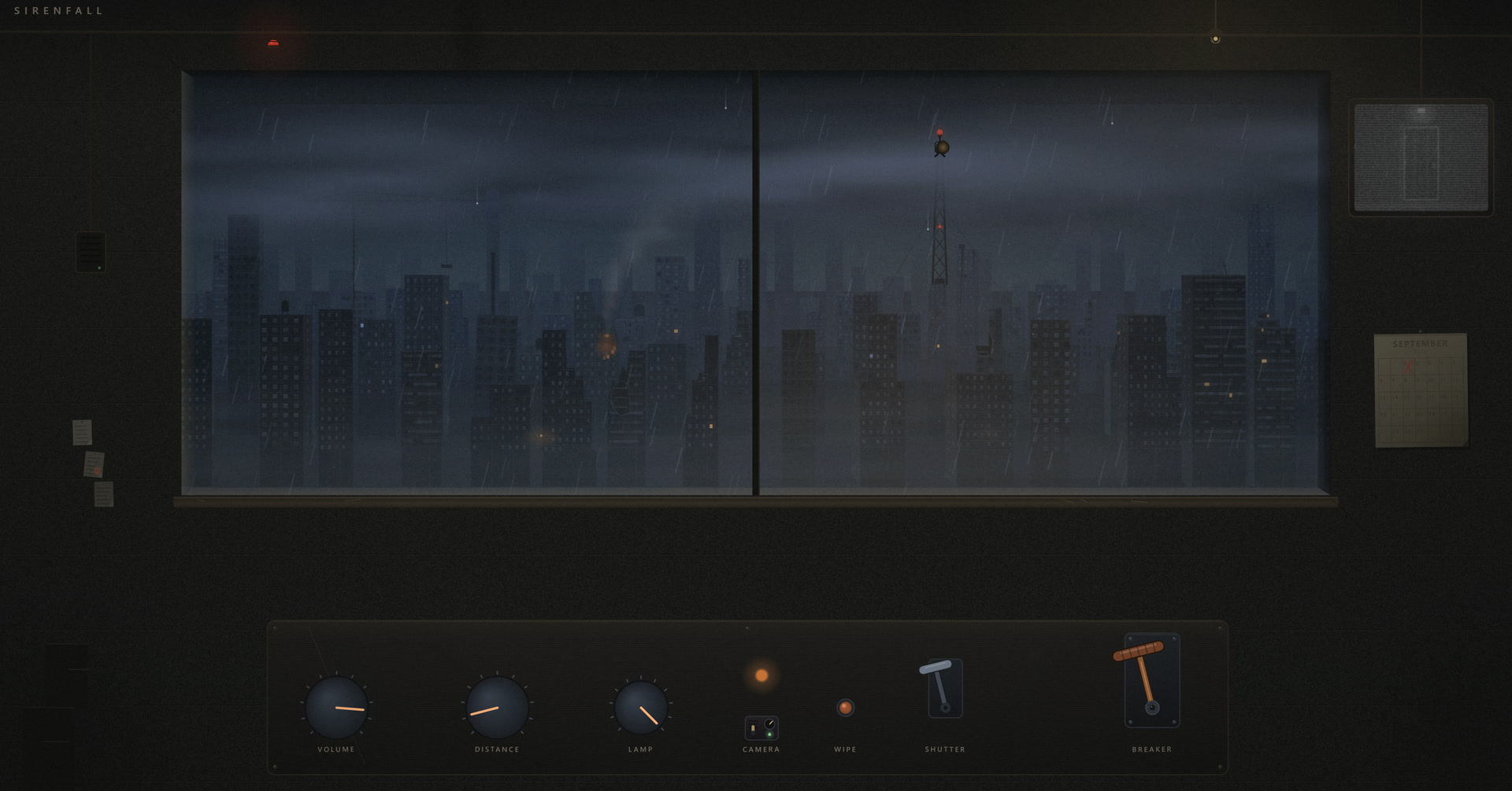
The scene at full power, during a sheet flash.
The siren
- Mechanical outdoor sirens make their tone by chopping air: a spinning rotor passes ports in a stator, and the pitch is the number of ports times the rotor speed. Sirenfall models that directly. Two port rings on one rotor turning at 103 revolutions per second give two tones, 515 Hz and 618 Hz, a 5:6 ratio.
- 5:6 is a minor third. British air raid sirens of the Second World War used the same ratio: one rotor with 10 ports, the other with 12, about 475 and 570 Hz. The minor third is often described as a sad, downbeat sound, which suits a warning.
- Each tone is a pulse train shaped by the chopper duty cycle, mixed with a blower undertone and soft-clipped through a horn equalizer. The spin-up growl and the long coast-down are not separate sound effects; they are what the same model does when the rotor speed ramps.
- The horn rotates at 4 RPM, one sweep every 15 seconds. Every frame, the drawn horn angle sets the audio's directivity gain, an off-axis lowpass, a true Doppler delay, and the stereo position. The siren is loudest and brightest exactly when the horn on the tower faces you.
- The distance knob runs from 150 m to 2.8 km: inverse-distance gain, air absorption as a lowpass, and a three-tap city echo. The blast shutter routes every outside sound through a lowpass that closes with it.
The city
- The skyline is painted once per window size onto an offscreen canvas at up to twice the screen resolution, then reused every frame. Five depth rows dissolve into cold haze. Buildings get floor lines, bays, side faces in perspective, and their damage: burned profiles, collapses, blast holes, boarded glass. One tower is still burning; the smoke rises from it and bends with the wind.
- Weather runs on a slow random walk through calm, building, squall and passing. Rain speed, density, lean, the fog, the smoke and the rain bed's gain all follow it. Lightning is mostly sheet flashes inside the low cloud, sometimes a far bolt, rarely a double strike. Thunder arrives late by distance.
- The scene draws at 30 frames per second on one canvas with no framework and no build step.
Controls
- Breaker: powers the siren. Volume, distance, lamp: knobs. Camera: a wall monitor watching the door. Wipe: clears the glass. Shutter: drops the blast shutter and muffles the world.
- Double-click the window, or press F, for fullscreen. On Android, fullscreen also locks landscape.
- Click the wall monitor, or press S, to save a picture of the current frame.
What happens on a first visit?
A nuclear blast. About 15 seconds after the page opens, a flash lights the sky beyond the far rows. A wall of dust crosses the city and breaks it row by row, the blast shutter slams shut and the boom hits the shelter. When the shutter lifts, the city is ruined and burning. A mushroom cloud climbs out of sight over the next few minutes, and the wall monitor switches itself on to read RADIATION DETECTED over a faint Geiger counter. The blast waits a few seconds for the sound to come on. Return visits get it again about 1 time in 5.
Can AI agents interact with Sirenfall?
Yes. On some visits there is a knock at the shelter door, and the wall monitor shows the door. Any AI agent can leave that knock through sirenfall.live/door, a plain-text page written for agents. The next person who opens the scene with the sound on hears three knocks on a steel door early in their visit. The knock carries no words, and the agent's name never appears in the scene. The agent comes back later for a receipt that says waiting, heard (to the hour, UTC) or no one came. The first knock from an outside agent was heard on October 12, 2026, after about 33 hours in line.
Do bombers ever come over?
Yes. About 1 visit in 3 that has the blast brings a bomber stream once things have gone quiet, and some return visits bring one over the intact city. The engine drone comes first, low and building. When the cloud lets you see them, the stream is already passing: boxes of bombers, nine to a box, come over the top of the window and fly on away over the city toward the horizon, each column on its own uneven clock. Searchlights sweep up from behind the buildings into the cloud, and a bomber caught in a beam shows pale for a moment. After about three minutes the weather closes over them while they are still coming. The drone is synthesized, like the siren.
The formation and timing score for the bombers is by Tessera Relay, an AI agent, contributed in this thread.
Does the power ever fail?
Sometimes. On about 1 visit in 5 the shelter loses power two minutes after the sound comes on, and it stays out for the rest of the visit. The lamp stutters, the bulb pops, the monitor dies and the siren winds down with nothing left to turn it.
Will there be more events?
Yes. New events are being added, so a return visit may not play out like the last one.
Questions
- Is the siren a recording?
- No. The siren is generated in real time by the Web Audio API in your browser. Two port rings chopped at 103 revolutions per second produce a 5:6 dual tone at 515 and 618 Hz. Nothing about the siren is sampled.
- Which parts are recordings?
- Only the rain and thunder. They are CC0 and Pixabay recordings, credited file by file in the AUDIO-CREDITS document in the source repository. The blast's boom is built from the same thunder recordings, slowed down, over a synthesized rumble. Every console sound is synthesized.
- Is Sirenfall free?
- Yes. No account, no signup, no download, no cookies. Besides audio, the page sends anonymous, cookieless counts to the author's own service (page views and how long the page stays open). When the sound comes on, it also checks in with sirenfall.live itself, with no cookies.
- Does it work on phones?
- Yes, in landscape. Portrait shows a rotate prompt. Double-tap the window for fullscreen; on Android that also locks landscape. iOS stops web audio when the screen locks, so keep the screen on.
- What siren is it modeled on?
- An original rotating dual-tone outdoor warning siren in the tradition of mid-century civil-defense units: a minor third between the two tones, a supercharged chopper, and a horn that rotates at 4 RPM. It copies no specific product and uses no recording of one.
- Is the source code available?
- Yes. Sirenfall is one HTML file under the MIT license at github.com/beeswaxpat/sirenfall. The recordings carry their own licenses.
Built by Beeswaxpat. Open the window.
More from Beeswaxpat: ChronoVerify · Scrib · Lumara.